


West Virginia State of Sex Ed
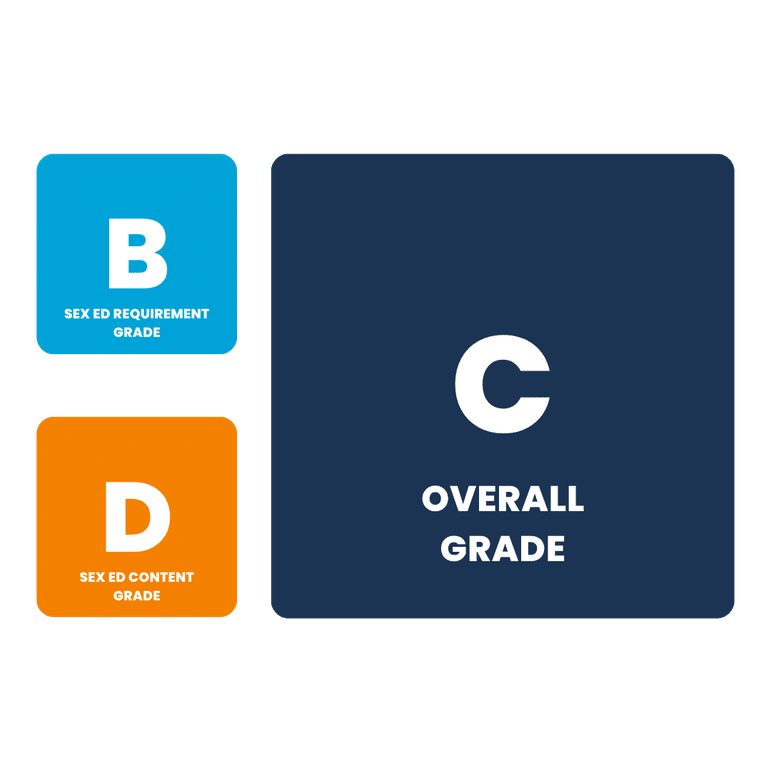
Current Requirement: West Virginia schools must teach health education, also known as wellness education.
- Curriculum must include instruction on HIV/STI prevention and contraception.
- Curriculum must include instruction on abstinence.
- West Virginia has no regulation on medically accurate sex education.
- Curriculum is not required to include instruction on sexual orientation or gender identity.
- Curriculum is not required to include instruction on consent.
- Parents or guardians may remove their children from any part of this instruction by written notification to the principal. This is referred to as an “opt-out” policy.
*In 2026, the overall grade of this state changed slightly from 2025 as a result of a change in our grading methodology. For more information on grading methodology, see the Executive Summary on the State Profiles webpage.
Recent Legislation Shaping the State Landscape
West Virginia advocates have worked hard to defend against attacks on sex education in recent years. In 2026, Senate Bill 412, House Bill 4100, and Senate Bill 51 were introduced and would have required fetal development instruction in wellness education, also known as “Baby Olivia” bills. Specifically, they would have required viewing of a high-definition fetal development video, produced by an extremist anti-abortion group, LiveAction, called “Meet Baby Olivia”. Bills like this aim to spread misinformation and perpetuate abortion stigma starting in early childhood. In the 2025 legislative session, three similar bills to reframe sex education failed: House Bill 2150, Senate Bill 94, and House Bill 2810. Similar bills (Senate Bill 468 and House Bill 5075) were also introduced in 2024.
In recent legislative sessions, another attack on sex education and abortion was bills requiring instruction on adoption within wellness education. Two bills (House Bill 4105 and House Bill 4698) were introduced to require adoption practices and resources to be discussed any time contraception or STIs are discussed, require instruction on adoption and safe haven laws when sex education is given, and require that instructional material include a description of child and human development. In 2025, a similar bill, House Bill 2810, was introduced. These bills aim to further feed into abortion stigma by platforming adoption as the “better choice”. So far, none of these restrictive attempts have succeeded.
Unfortunately, progressive attempts have also been unsuccessful so far. In 2026, Senate Bill 124. It would have required instruction in grades 3-6 on child sexual abuse prevention, personal safety, and assault prevention, and dating violence and sexual violence prevention education in grades 7-12. This bill failed to pass by the end of the session.
Advocates in Action
Advocates can take action to ensure that young people in West Virginia have access to quality sex education. Advocates can contact their representatives to discuss improving the quality of sex education in West Virginia schools and aligning existing state standards with the National Sex Education Standards, and the need to defend against harmful and restrictive legislative attempts. Advocates are encouraged to use the Community Action Toolkit to strengthen local organizing efforts. For additional guidance, advocates can contact the SIECUS Policy team by emailing [email protected] or join the Sexuality Education Policy Action Council (SEPAC) using our interest form.
More on Sex Ed in West Virginia…
State Law: A Closer Look
West Virginia law (West Virginia Code §18-2-9) requires “course curriculum requirements and materials [to] be adopted by the state board by rule in consultation with the Department of Health and Human Resources.” This means all school districts must adhere to the West Virginia College- and Career-Readiness Standards for Wellness Education, which cover several sexual health concepts addressed below.
West Virginia Code §18-2-9 also requires human immunodeficiency virus (HIV)/acquired immunodeficiency syndrome (AIDS) prevention education within the general health education curriculum in grades 6–12. According to the West Virginia Board of Education’s AIDS Education Policy 2422.4, “[t]he goal of this policy is to assist in the protection of students by providing them with the knowledge and skills necessary to avoid behaviors that will put them at the risk of infection with [HIV].” Each county board must integrate HIV prevention education into health courses and may also include it in “science, social studies, and developmental guidance” courses to “assure total understanding of the disease and its consequences.” Educators conducting classroom instruction about HIV/AIDS must be qualified professionals who participate in staff development to ensure they teach current health information.
Parents or guardians may remove their children from any part of this instruction by written notification to the principal. This is referred to as an “opt-out” policy.
State Standards
West Virginia’s Board of Education’s West Virginia College- and Career-Readiness Standards for Wellness Education curriculum framework includes sexual health. The standards include discussion on communicable disease prevention and transmission, including HIV and sexually transmitted diseases (STDs), the functions of the reproductive system, and “factors that lead to teen pregnancy,” as well as methods to prevent pregnancy. School districts must adhere to these standards when deciding on curriculum.
Youth Sexual Health Data
The CDC’s Youth Risk Behavior Survey (YRBS) tracks adolescent health behaviors, including sexual health behaviors. To learn more about West Virginia’s 2023 YRBS results, click here. The CDC’s School Health Profiles measure school health policies, practices, and the sexual health topics taught in schools. West Virginia’s results were not representative for the 2024 School Health Profiles Survey. Visit the CDC’s School Health Profiles for additional information on school health policies and practices.
The quality of sex education taught often reflects funding available for sex education programs. To learn more about federal funding streams, click here.