


Texas State of Sex Ed
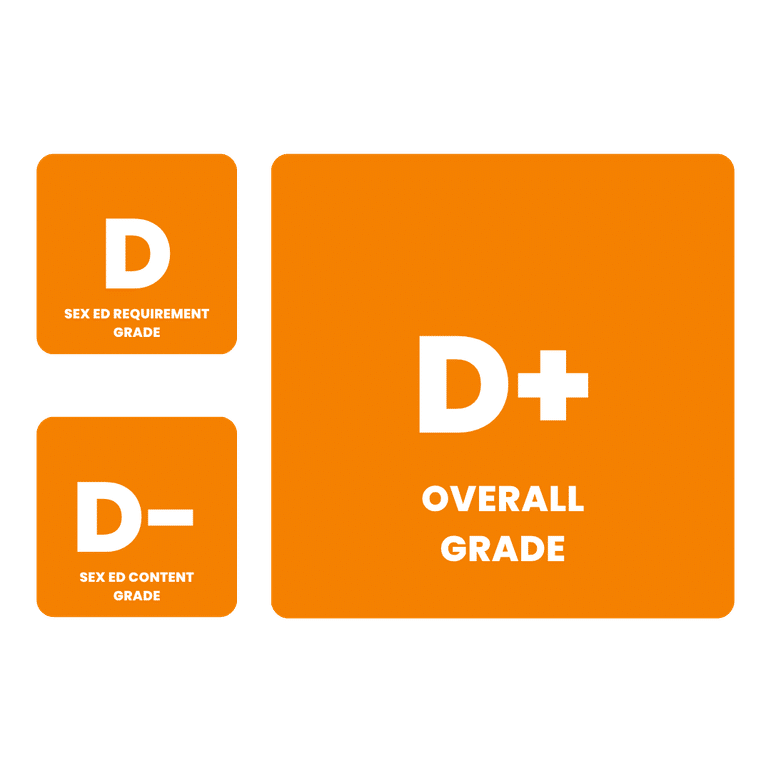
Current Requirement: Texas requires health education that includes sexual health topics under state standards in the administrative code.
- As part of health education, schools must provide instruction in anatomy, healthy relationships, contraception, and STI prevention while emphasizing abstinence, otherwise known as an “abstinence-plus” curriculum.
- If a school chooses to teach sex education, it must state that homosexuality is not an acceptable lifestyle to the general public and that it is a criminal offense under the Texas Penal Code. Curriculum restricts instruction on sexual orientation and gender identity pre-K-12
- Curriculum is also required to specifically instruct on adoption as an alternative to parenting, excluding any mention of abortion.
- Curriculum is not required to include instruction on consent.
- Parents or guardians are required to provide their written consent prior to their children receiving sex education. This is called an “opt-in” policy.
- Texas has no regulation regarding medically accurate sex education instruction.
Recent Legislation Shaping the State Landscape
Texas does not convene in even years and therefore had no legislative developments in 2026.
In 2025, over 30 bills were introduced regarding sex education in Texas, the majority of which were restrictive. Two bills, Senate Bill 12 and Senate Bill 1207, were enacted into law. Senate Bill 12, a so-called parental rights law, passed, cementing a parental opt-in policy for sex education in state law and prohibiting any instruction on sexual orientation and gender identity in grades pre-K through twelve, alongside other parental rights clauses.
At the intersection of sex education and abortion access, legislation attempting to require unnecessary “fetal development” instruction (“Baby Olivia” bills) or instruction on adoption, at the exclusion of abortion, was also introduced in 2025. While the Baby Olivia bills (House Bill 196, House Bill 3739, House Bill 4208, House Bill 3972, and Senate Bill 205) failed, Senate Bill 1207 passed and requires specific instruction on adoption as an alternative to parenting within the health curriculum. This allows biased instruction on pregnancy outcomes and perpetuates abortion stigma in the classroom.
Advocates in Action
With the passage of Senate Bill 12, advocates can take action to ensure young people in Texas have unrestricted access to sex education by pushing lawmakers to repeal the opt-in policy and SOGI ban. At the local school board level, advocates can determine whether abstinence-plus instruction is being taught and whether the curriculum aligns with current Texas Essential Knowledge and Skills (TEKS) for Health Education standards. They can then vocalize the importance of advancing sex education requirements in their community beyond emphasizing abstinence to meet the needs of all young Texans. Advocates can also advocate to align the TEKS with the National Sex Education Standards. Additionally, advocates must remain vigilant and defend against continuous attacks on sex education that seek to require stigmatizing and inappropriate “fetal development” instruction.
Advocates can also contact state legislators to support a statewide comprehensive sex education mandate and use the Community Action Toolkit to strengthen local organizing efforts. For additional guidance, advocates can contact the SIECUS Policy team by emailing [email protected] or join the Sexuality Education Policy Action Council (SEPAC) using our interest form.
More on Sex Ed in Texas…
State Law: A Closer Look
Neither sex education nor education on human immunodeficiency virus (HIV) and other sexually transmitted infections (STIs) are statutorily mandated in Texas. However, Texas Education Code §7.102(c)(11) requires the State Board of Education to “adopt rules to carry out the curriculum required or authorized under §28.002,” which includes “health.” This means all school districts must adhere to the Texas Essential Knowledge and Skills for Health Education standards. Accordingly, Texas Education Code §§ 28.004, Texas State Board of Education Administrative Code §§ 115.22, 115.23, 115.32, and 115.33 require that all “course materials and instruction relating to human sexuality” must:
- Present abstinence from sexual activity as the preferred choice of behavior in relationship to all sexual activity for unmarried persons of school age;
- Devote more attention to abstinence from sexual activity than to any other behavior;
- Emphasize that abstinence from sexual activity, if used consistently and correctly, is the only method that is 100% effective in preventing pregnancy, sexually transmitted diseases (STDs), infection with HIV or acquired immune deficiency syndrome (AIDS), and the emotional trauma associated with adolescent sexual activity;
- Direct adolescents to a standard of behavior in which abstinence from sexual activity before marriage is the most effective way to prevent pregnancy, STDs, and infection with HIV or AIDS; and
- Teach contraception and condom use in terms of human-use reality rates instead of theoretical laboratory rates, if instruction on contraception and condoms is included in curriculum content.
School districts may not distribute condoms and are allowed to “separate students according to sex for instructional purposes.” Each school district must also establish a local health advisory council through its board of trustees. The council must make recommendations to the school district about changes in that district’s curriculum and “appropriate grade levels and methods of instruction for human sexuality instruction.”[v] This council also must “assist the district in ensuring that local community values are reflected in the district’s health education instruction.”
Texas Health and Safety Code §85.007 and §163.002 state that course materials and instruction must “state that homosexual conduct is not an acceptable lifestyle to the general public and is a criminal offense under Section 21.06, Penal Code,” a common “no promotion of homosexuality” style law. This ruling applies if DSHS develops the curriculum. The United States Supreme Court handed down a decision in Lawrence v. Texas that declared state laws criminalizing homosexual behavior to be unconstitutional in 2003, invalidating Section 21.06 despite it remaining in the Texas Code. Further, the following clause was enacted as a result of SB 12:
“Sec. 28.0043 RESTRICTION ON INSTRUCTION REGARDING SEXUAL ORIENTATION AND GENDER IDENTITY. (a) A school district, open-enrollment charter school, or district or charter school employee may not provide or allow a third party to provide instruction, guidance, activities, or programming regarding sexual orientation or gender identity to students enrolled in prekindergarten through 12th grade.”
Under Texas Education Code § 28.004, subsection (i-2), before providing any instruction in human sexuality, schools must obtain written parental consent; anti-sex ed lawmakers permanently extended this clause in the 2025 session with the passage of SB 12. This is called an “opt-in” policy.
Lastly, the passage of SB 1207 requires the following to be included within parenting and paternity awareness curriculum under health education:
“(2) include information related to adoption, including information about:
(A) the differences between private adoption and foster care;
(B) the process for adopting a child privately or through the state foster care system; and
(C) adoption as an alternative to becoming a parent and the process for placing a child for adoption;.”
State Standards
In 2020, the Texas Essential Knowledge and Skills for Health Education were revised and included instruction on anatomy, contraception (including condoms), and STI prevention in middle and high school while continuing to emphasize abstinence. It also added standards on healthy relationships and the importance of physical boundaries.
Youth Sexual Health Data
The CDC’s Youth Risk Behavior Survey (YRBS) tracks adolescent health behaviors, including sexual health behaviors. Texas did not collect data on sexual behavior outcomes, outside of sexual and dating violence,e in 2023. To learn more about Texas’s 2023 YRBS results, click here. The CDC’s School Health Profiles measure school health policies, practices, and the sexual health topics taught in schools. Data on Texas was not available for the 2024 School Health Profiles, except for representative data from Houston, Texas. To view 2024 School Health Profiles Data for Houston, Texas, visit the School Health Profiles Explorer Tool. Visit the CDC’s School Health Profiles for additional information on school health policies and practices.
The quality of sex education taught often reflects funding available for sex education programs. To learn more about federal funding streams, click here.