


Oregon State of Sex Ed
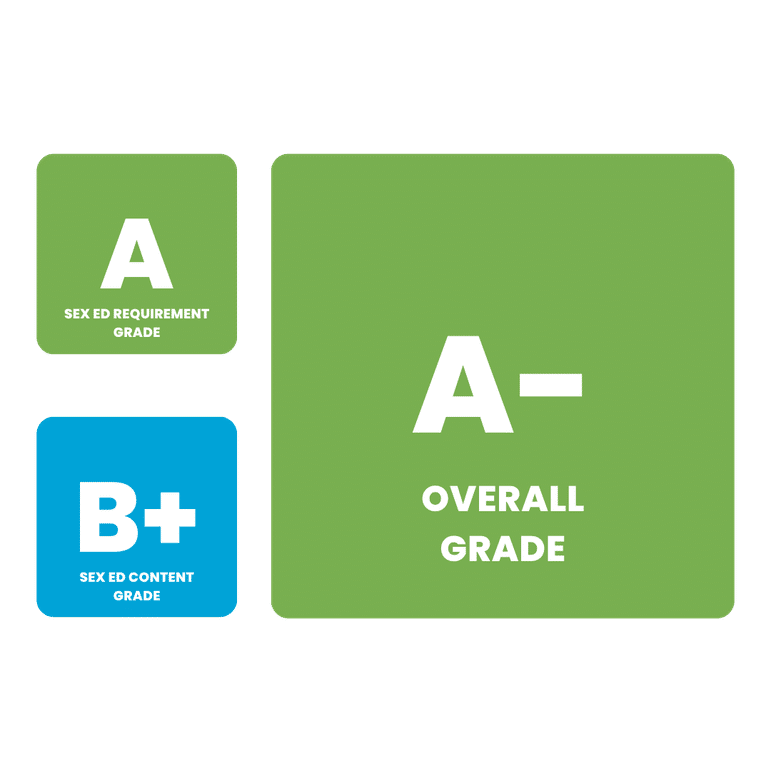
Current Requirement: Oregon requires sex education, and each school district must provide K-12 human sexuality education courses that follow the developed standards.
- Curriculum must be comprehensive but must also promote abstinence.
- Oregon law requires sex education to be age-appropriate, medically accurate, not shame- or fear-based, and LGBTQIA+ inclusive.
- Curriculum must include instruction on consent.
- Parents or guardians may remove their children from sex education instruction. This is called an “opt-out” policy.
In 2026, this state’s overall grade changed slightly from 2025 because of a change in our grading methodology. For more information on grading methodology, see the Executive Summary on the State Profiles webpage.
Recent Legislation Shaping the State Landscape
Oregon has had no sex education-specific legislative developments in the 2026 legislative session.
In 2025, four regressive sex education bills were introduced that would have allowed for biased instruction that aims to stigmatize abortion, but failed. Senate Bill 882 and Senate Bill 918 would have required instruction on human development starting at “conception,” and House Bill 3459 would have required viewing of a video on organ development and one on fertilization and every significant stage of pregnancy, starting in 3rd grade. This is yet another version of biased “fetal development” instructional requirements, also known as “Baby Olivia” bills. Additionally, House Bill 3454 would have required schools to unnecessarily provide information on adoption any time contraception, sexually transmitted infections (STIs), or testing for STIs are discussed with students.
While several regressive bills are introduced each session, advocates and lawmakers continue to block these efforts and maintain access to comprehensive sex education in Oregon.
Advocates in Action
Despite a state mandate and supporting policies, challenges to implementing CSE statewide remain, and advocates report that the quality of sex education students receive varies greatly depending on their school district. To address these disparities, advocates can recommend statewide participation in the Student Health Survey to assess implementation, push for better training and professional development for educators and administrators, require the Oregon Department of Education to establish mechanisms to monitor and enforce compliance, and leverage federal funding to advance sex education policy and implementation.
Advocates can also contact their representatives to discuss the critical need to protect the statewide mandate and continue pushing back against regressive legislative attempts. Advocates are encouraged to use the Community Action Toolkit to strengthen local organizing efforts. For additional guidance, advocates can contact the SIECUS Policy team by emailing [email protected] or join the Sexuality Education Policy Action Council (SEPAC) using our interest form.
More on Sex Ed in Oregon…
State Law: A Closer Look
Oregon Revised Statutes §§ 336.035, 336.455, and 336.465, as well as Oregon Administrative Rules §§ 581-022-2030 and 581-022-2050, mandate human sexuality education and instruction in infectious diseases, including human immunodeficiency virus (HIV)/acquired immunodeficiency syndrome (AIDS), and sexually transmitted infection prevention, throughout elementary and secondary school. Students in grades 6-8 must receive instruction at least once annually, while students in grades 9-12 must receive instruction twice annually. Oregon does not suggest or recommend a curriculum. However, 336.455 states that:
2) Course Instruction shall:
- Be medically accurate …
- Include information about responsible sexual behaviors and hygienic practices that eliminate or reduce the risks of pregnancy and the risks of exposure to HIV, hepatitis B, hepatitis C, and other infectious or STIs. Information about those risks shall be presented in a manner designed to allay fears concerning risks that are scientifically groundless.
- Promote abstinence for school-age youth and mutually monogamous relationships with an uninfected partner for adults as the most effective way to prevent pregnancy and the transmission of STDs; however, abstinence may not be taught to the exclusion of other material and instruction on contraceptive and disease reduction measures;
Furthermore, the comprehensive plan of instruction must include information that:
- Provides balanced, accurate information and skills-based learning on the risks and benefits of contraceptive and disease reduction measures that reduce the risk of unintended pregnancy, exposure to HIV, hepatitis B/C, and other sexually transmitted infections (STIs) and diseases; …
- Discusses the benefits of delaying pregnancy beyond the adolescent years as a means better to ensure a healthy future for parents and their children. Students shall be provided with statistics based on the latest medical information regarding both the health benefits and the possible side effects of all forms of contraceptives, including the success and failure rates for prevention of pregnancy, STIs, and diseases; …
- Encourages positive family communication and involvement and helps students learn to make responsible, respectful, and healthy decisions; …
- Validates through course material and instruction the importance of honesty with oneself and others, respect for each person’s dignity and well-being, and responsibility for one’s actions; and
- Uses inclusive materials, language, and strategies that recognize different sexual orientations, gender identities, and gender expression.
Sex education courses must also include information on teen dating violence and “must be presented in a manner sensitive to the fact that there are students who have experienced sexual abuse” and must not devalue or ignore students who have engaged in sexual intercourse.
Teachers may not “be subject to discipline or removal for teaching or refusing to teach courses concerning” STDs. Parents or guardians may remove their children from sex education and/or STD/HIV education classes. This is called an “opt-out” policy.
Moreover, an administrative rule provides specific guidelines that communities must follow when creating their own plan. Community members must develop the plans locally, drawing on evidence-based strategies, and local school boards must approve them and review them biennially in light of new scientific information.
State Standards
According to OAR 581-022-2030, each school district shall provide a planned K–12 instructional program, including the academic content standards adopted by the State Board of Education. Oregon’s K- 12 Health Education Standards were updated in 2023 and provide a foundation for curriculum development. Oregon Standards reflect the National Health Education Standards and the National Sexuality Education Standards, which focus on knowledge and skill development for health literacy. The promotion of sexual health constitutes its own “strand” of learning. Concepts covered include “recogniz[ing] diversity among people, including age, disability, national origin, race, ethnicity, color, marital status, biological sex, sexual orientation, gender identity, and expression…set[ting] a personal goal to not have sex until you’re ready,” as well as, “use protection when sexually active” and “demonstrat[ing] ways to communicate decisions about whether or when to engage in sexual behaviors and to practice safer sex.”
Youth Sexual Health Data
Oregon does not participate in CDC’s Youth Risk Behavior Surveillance; instead, it conducts the State Student Health Survey. The Student Health Survey is a comprehensive, school-based, anonymous, voluntary health survey of 6th-, 8th-, and 11th-graders, administered annually. To learn more about Oregon’s most recent Student Health Survey (SHS) results (2025), click here. The CDC’s School Health Profiles measure school health policies, practices, and the sexual health topics taught in schools. To view Oregon’s results from the 2024 School Health Profiles Survey, visit CDC’s School Health Profiles Explorer tool. Visit the CDC’s School Health Profiles for additional information on school health policies and practices.
The quality of sex education taught often reflects funding available for sex education programs. To learn more about federal funding streams, click here.