


North Dakota State of Sex Ed
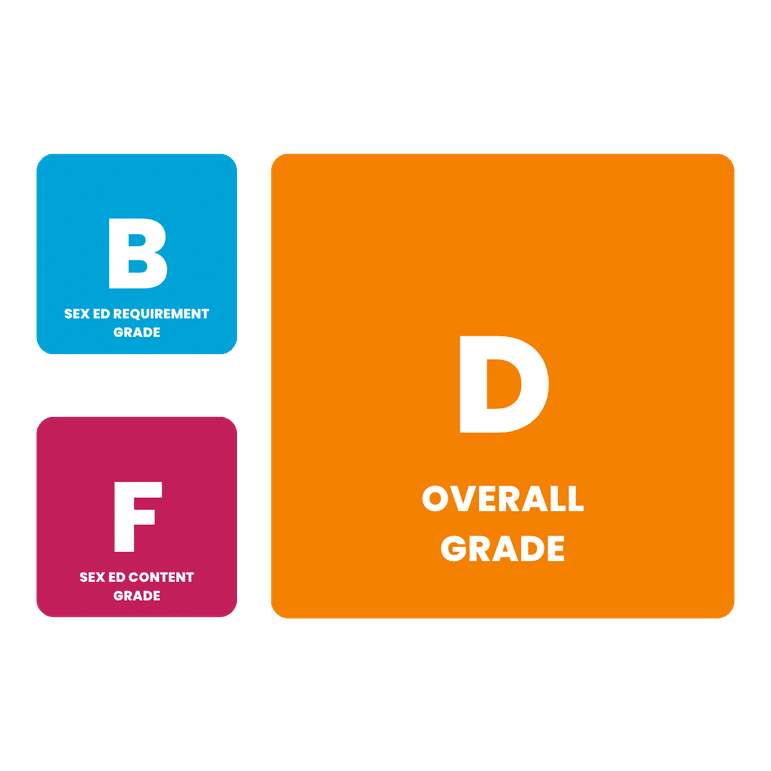
Current Requirement: North Dakota schools must teach health education, including sex education, and follow state standards.
- Curriculum must be abstinence-based.
- North Dakota has no regulation regarding medically accurate sex education instruction.
- Curriculum is not required to include instruction on sexual orientation or gender identity. However, the North Dakota Health Education Content Standards include discussion of sexual orientation in their definition of sexuality.
- Curriculum is not required to include instruction on consent.
- Curriculum must include instruction on human growth and development, incorporating materials like fetal ultrasound videos.
- North Dakota statute has no standard regarding the ability of parents and guardians to remove their children from sex education instruction.
*In 2026, the overall grade of this state changed slightly from 2025 as a result of a change in our grading methodology. For more information on grading methodology, see the Executive Summary on the State Profiles webpage.
Recent Legislation Shaping the State Landscape
North Dakota does not convene in even years and therefore had no legislative developments in 2026. While North Dakota did not have any sex education-specific bills since the passage of their “Baby Olivia” law in 2023, other related legislative efforts have been aimed at targeting LGBTQIA+ students and inclusive content in schools through so-called “parental rights” legislation. In 2025, House Bill 1144 was enacted and prohibits schools from developing policies that address transgender students without parental permission, including inclusive bathrooms and pronoun usage. Laws like this create hostile school environments for LGBTQIA+ students and impede their ability to learn in the classroom, even if not directly restricting sex education.
One positive bill was also enacted in 2025, Senate Bill 2330, which initially held promise by requiring human trafficking and exploitation prevention education as part of health education, but was significantly watered down through amendments that stripped away strong instructional requirements before it passed.
Advocates in Action
Advocates can take action to push for better, more comprehensive sex education for young people in North Dakota. Advocates can also contact their local school board to determine what curriculum is currently being used to teach sex education under health education and if that instruction is biased or stigmatizing, including if the “Meet Baby Olivia” video is being shown in the classroom.
Advocates can also contact their representatives to discuss the critical need for a statewide sex education mandate. Advocates are encouraged to use the Community Action Toolkit to strengthen local organizing efforts. For additional guidance, advocates can contact the SIECUS Policy team by emailing [email protected] or join the Sexuality Education Policy Action Council (SEPAC) using our interest form.
More on Sex Ed in North Dakota…
State Law: A Closer Look
Under North Dakota Century Code Title 15.1-21-24, beginning July 1, 2012, every school district, both public and non-public, must include instruction on abstinence in its health education curriculum. Each school district needs to ensure that the portion of its health curriculum related to sexual health includes instruction about “the risks associated with adolescent sexual activity and the social, psychological, and physical health gains to be realized by abstaining from sexual activity before and outside of marriage.”
In 2021, North Dakota Century Code Title 15.1-21-24 was further amended after the passage of SB 2311 to say: “The district or nonpublic school’s health curriculum for all students in grades seven through twelve includes instruction in mental health awareness and suicide prevention, including instruction and information on identifying warning signs and risk factors, identifying at – risk peers, and the availability of resources. To satisfy the requirements of this subsection, a district or nonpublic school may collaborate with other districts and nonpublic schools to share resources and provide instruction through distance or virtual learning.”
During the 2023 legislative session, North Dakota Century Code Title 15.1-21-28 was amended to require all school districts offering human sexuality instruction to include:
- A high-definition ultrasound video, at least three minutes in duration, showing the development of the brain, heart, sex organs, and other vital organs in early fetal development; and
- A high-quality, computer-generated rendering or animation showing the process of fertilization and every stage of human development inside the uterus, noting significant markers in cell growth and organ development for every week of pregnancy until birth.
North Dakota was the first state to mandate this kind of instruction, and while it does not require viewing Live Action’s problematic “Meet Baby Olivia” video, the North Dakota Department of Public Instruction lists it as a sufficient option to meet the requirement.
State Standards
The North Dakota Health Education Content Standards, most recently updated in 2026, published by the North Dakota Department of Public Instruction, establish benchmarks for health instruction at all grade levels. For example, in grades 3-5, students are expected to “Explain the stages of social, emotional, physical, and mental growth and development in humans from infancy to late adulthood,” including puberty. The standards address “sexual behavior” beginning in grade 6. Aligning a school district’s health curriculum with the 2026 North Dakota Health Education Content Standards is intended to assure compliance with the law.
Youth Sexual Health Data
The CDC’s Youth Risk Behavior Survey (YRBS) tracks adolescent health behaviors, including sexual health behaviors. To learn more about North Dakota’s 2023 YRBS results, click here. The CDC’s School Health Profiles measure school health policies, practices, and the sexual health topics taught in schools. To view North Dakota’s results from the 2024 School Health Profiles Survey, visit CDC’s School Health Profiles Explorer tool. Visit the CDC’s School Health Profiles for additional information on school health policies and practices.
The quality of sex education taught often reflects funding available for sex education programs. To learn more about federal funding streams, click here.