


Louisiana State of Sex Ed
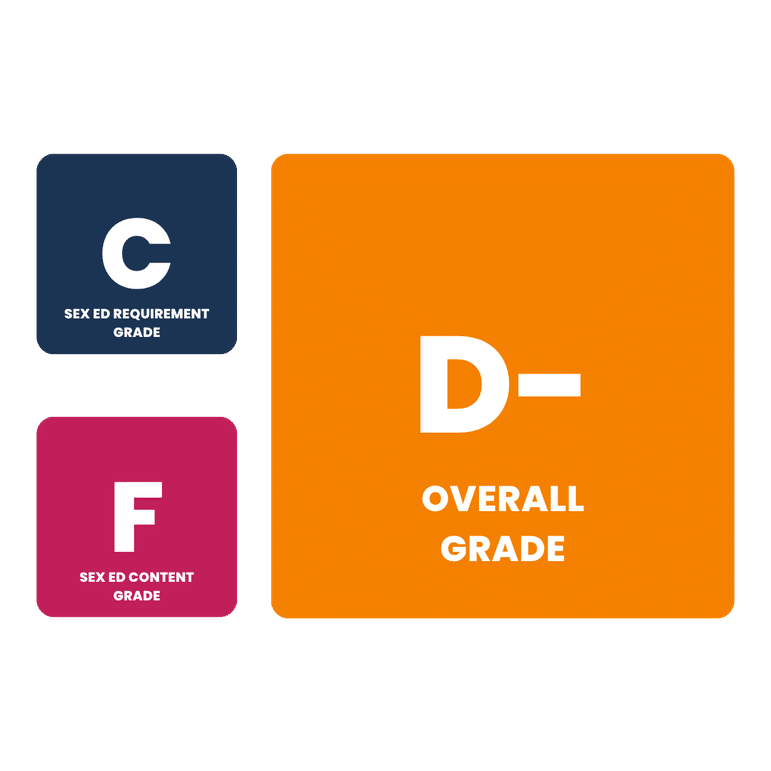
Current Requirement: Louisiana schools must teach some sex education by proxy through mandated health education standards. If sex education is offered, the curriculum must emphasize abstinence as the expected social standard.
- There is no regulation regarding medically accurate sex education instruction. However, if a school chooses to teach sex education, instruction must be “based on factual biological or pathological information.”
- If sex education is offered, curriculum must not include any sexually explicit materials depicting homosexual activity.
- Instruction and discussion on sexual orientation and gender identity (SOGI) is prohibited in grades K-12.
- Curriculum is not required to include instruction on consent.
- Parents or guardians may remove their children from sex education classes. This is referred to as an “opt-out” policy.
Recent Legislation Shaping the State Landscape
During Louisiana’s 2026 legislative session, lawmakers continued advancing legislation that uses schools and educational settings to promote regressive, anti-abortion, and abstinence-oriented ideologies. House Concurrent Resolution 26 requires the State Board of Elementary and Secondary Education (BESE) to incorporate “human growth and development, including but not limited to prenatal development” into state content standards for science or health education and to provide materials including a “computer-generated animation showing the development of vital organs in the early stages of human fetal development” to support instruction on “human development from conception to birth.” While the resolution does not explicitly mention Live Action’s “Meet Baby Olivia” video, these requirements closely mirror other fetal development legislation. There is no science-based or education-based justification for including this video or these fetal development lessons in sex education. Their only purpose is to spread misinformation and create stigma around abortion and reproductive health care.
Louisiana also enacted Senate Bill 310 (2026), the “Signs of Hope Act,” requiring school health centers in public high schools, colleges, and universities to display state-approved pregnancy-resource signs in each patient admission area, waiting room, and consultation room. The signs must state, “Pregnant? Help Is Available for You and Your Baby!” and include a link to the Louisiana Department of Health’s pregnancy resources. Notably, the law repeatedly references an unnamed “designated nonprofit organization,” which may be authorized to design and produce the signs, while explicitly stating that LDH does not have to use its own funds to purchase them and may instead accept donated signs. Although the statute does not identify the nonprofit, advocates on the ground report that crisis pregnancy centers are expected to fill this role, creating another avenue for these organizations to bring their distorted messaging into school health settings.
Lawmakers additionally attempted to advance Senate Bill 269 (2026), the “Charlie Kirk Success Sequencing Act,” which died in committee. The bill would have required public and approved nonpublic schools to provide instruction and informational materials on the “success sequence.” It would have allowed the Department of Education to engage “nonprofit organizations, and other interested stakeholders” to develop guidance. Taken together, these measures reflect a broader strategy to use science standards, school health centers, and student-success programming as vehicles for ideological messaging, while creating opportunities for outside organizations to shape what students learn instead of ensuring access to comprehensive, medically accurate, and age-appropriate sexuality education.
Advocates in Action
Advocates can work to raise community awareness about the limitations of Louisiana’s sex education requirements and connect young people with trusted, comprehensive community programming. Additionally, advocates should remain vigilant in monitoring the implementation of new “fetal development” and “success sequence” requirements and push back against efforts to introduce stigmatizing or medically misleading content into schools and school health settings. Advocates can also monitor the implementation of the “Signs of Hope Act” and raise awareness about the potential involvement of crisis pregnancy centers in providing pregnancy-resource materials to students.
Advocates can also contact state legislators to support a statewide comprehensive sex education mandate and use the Community Action Toolkit to strengthen local organizing efforts. For additional guidance, advocates can contact the SIECUS Policy team by emailing [email protected] or join the Sexuality Education Policy Action Council (SEPAC) using our interest form.
More on Sex Ed in Louisiana…
State Law: A Closer Look
Louisiana statute does not require schools to offer sex education. Still, Louisiana Revised Statute §17:24.4(E) states that “the State Board of Elementary and Secondary Education … shall develop and establish statewide curriculum standards for required subjects to be taught in the public elementary and secondary schools of [the] state.” Starting in the 2014-2015 school year, all incoming 9th graders must take 1/2 credit of health education. Under this authority, the Board of Elementary and Secondary Education promulgated Part LIX. Bulletin 103 describes the state’s health education content standards. From grades 7–12, students learn about sexual abstinence and sexual risk behaviors; in grades 4 and 7–12, students receive human immunodeficiency virus (HIV)/acquired immunodeficiency syndrome (AIDS) and other sexually transmitted disease (STD) education.
Louisiana Revised Statute §§17:281 prohibits sex education in grades K–6, except in Orleans Parish, which may offer sex education in grade 3 and above. However, schools must provide sex education “regardless of the student’s grade level” if an enrolled student is pregnant or parenting. The education must be integrated into “an existing course of study such as biology, science, physical hygiene, or physical education.” It cannot include “religious beliefs, practices in human sexuality, nor the subjective moral and ethical judgments of the instructor or other persons. Students shall not be tested, quizzed, or surveyed about their personal or family beliefs or practices in sex, morality, or religion.”
Classes may not include “any sexually explicit materials depicting male or female homosexual activity.” They also may not in any way counsel or advocate abortion. In addition, this education must emphasize that:
- Abstinence from sexual activity outside of marriage is the expected standard for all school-age children;
- Abstinence from sexual activity is a way to avoid unwanted pregnancy, STDs, including AIDS, and other associated health problems;
- Each student has the power to control personal behavior and to encourage students to base action on reasoning, self-esteem, and respect for others.
Louisiana Revised Statute §§17:279 requires all public high schools offering home economics classes to provide “parenthood education” and include the following topics about family living and community relationships: the consequences of inadequate prenatal care, home management, and the responsibilities of parenthood. In addition, Louisiana Revised Statutes Annotated § 17:263 requires that any health education or appropriate class include adoption awareness. This includes instruction on “the benefits of adoption for families wishing to add a child, for potential adoptees, and for persons who are pregnant or who have a child for whom they are unable to care.”
In 2018, Louisiana enacted Act 369, requiring schools to provide parents with information regarding “the public health risks and harms associated with pornography,” including “the dangers of sexually charged cyberbullying,” as well as “the addictive and destructive nature of pornographic and illicit materials.”
In 2024, through the passage of House Bill 122, Louisiana law was revised (LA Rev Stat § 17:412) to prohibit instruction and discussion on sexual orientation and gender identity (SOGI). Stating:
A. No teacher, school employee, or other presenter at a school shall engage in the following discussions with students in grades kindergarten through twelve:
(1) Covering the topics of sexual orientation or gender identity in any classroom discussion or instruction in a manner that deviates from state content standards or curricula developed or approved by public school governing authorities.
(2) Covering the topics of sexual orientation or gender identity during any extracurricular academic, athletic, or social activity under the jurisdiction of the school or public school governing authority.
(3) Discussing his own sexual orientation or gender identity.
B. Nothing in this Section shall be construed to mean that a student may not seek out guidance from a teacher or licensed mental health professional outside classroom hours with prior parental consent.
Parents or guardians may remove their children from sex education classes. This is called an “opt-out” policy.
State Standards
Louisiana’s Health Education Handbook outlines expectations that should be mastered by the end of each grade level and defines sexual health as:
“[T]he area of health education encompassing a broad scope of concepts and skills, including acquiring information about sexual development, reproductive health, interpersonal relationships, body image, and gender roles; recognizing habits that protect female and male reproductive health; and learning about pregnancy, childbirth, and the development of infants and children. It also includes skill development in areas such as communication, decision-making, refusal techniques, and goal-setting. Sexual health topics are grounded in the premise that sexuality is a natural, ongoing process that begins in infancy and continues through life.”
The handbook also delineates abstinence as the “safest, most effective risk avoidance method of protection from HIV, STDs, and pregnancy.
Furthermore, according to the Louisiana Handbook for School Administrators- Bulletin 741, students must be taught “the principal modes by which communicable diseases, including, but not limited to, HIV infection, are spread and the best methods for the restriction and prevention of these diseases.” Schools are prohibited from distributing any “contraceptive or abortifacient drug, device, or other similar product.”
Youth Sexual Health Data
The CDC’s Youth Risk Behavior Survey (YRBS) tracks six categories of health risk behaviors, including sexual health behaviors. To learn more about Louisiana’s 2023 YRBS results, click here. The CDC’s School Health Profiles measure school health policies, practices, and the sexual health topics taught in schools. Louisiana’s 2024 School Health Profiles response rate was not high enough to be representative and thus is excluded from the CDC’s School Health Profiles Explorer tool. Visit the CDC’s School Health Profiles for additional information on school health policies and practices.
The quality of sex education taught often reflects funding available for sex education programs. To learn more about federal funding streams, click here.