


Florida State of Sex Ed
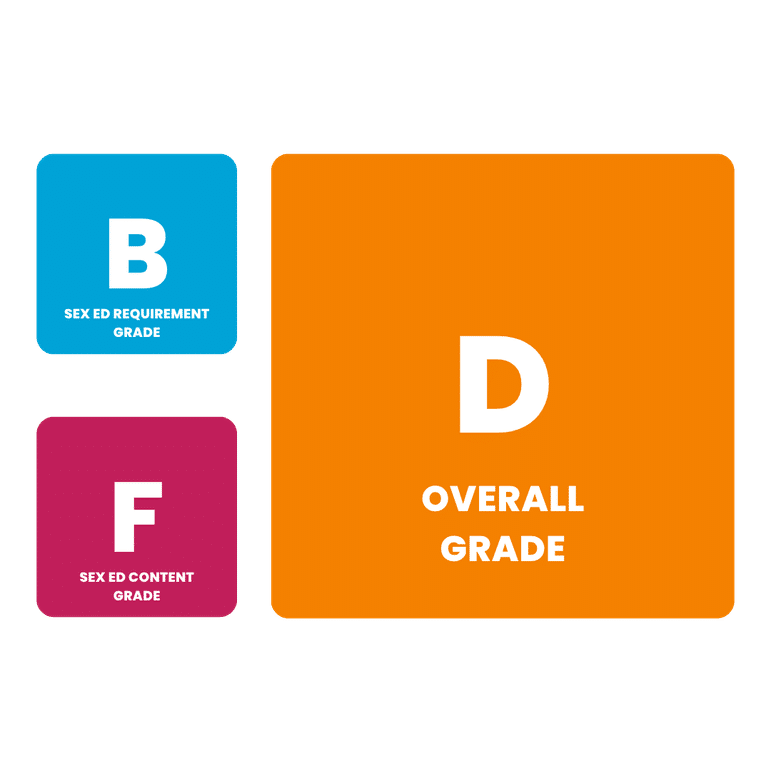
Current Requirement: Florida schools are not required to teach sex education. While they are required to teach health education that includes instruction on “the consequences of teenage pregnancy” and some aspects of sex education, all instructional materials used for reproductive health, HIV/AIDS, STIs, health education, or any instruction containing human sexuality must be approved by the Florida Department of Education before instruction.
- Curriculum must include the benefits of abstinence as the “expected standard.”
- Curriculum must teach prevention of child sexual abuse, exploitation, and trafficking but is not required to include instruction on consent.
- Florida has no regulation regarding medically accurate sex education instruction.
- If schools in Florida choose to provide further instruction on HIV/AIDS, the instruction must emphasize the “benefits of heterosexual marriage”, must be age and developmentally appropriate, and must be approved by the Department of Education.
- Classroom instruction on sexual orientation and gender identity is prohibited in grades K-8.
- Parents or guardians may submit a written request to remove their children from instruction on reproductive health or any disease. This is referred to as an “opt-out” policy.
Recent Legislation Shaping the State Landscape
During the 2026 legislative session, advocates were effective for the second consecutive year in stopping the passage of regressive bills like Senate Bill 1090 and House Bill 1071, which attempted to require unnecessary “fetal development” instruction. However, for the third consecutive year, advocates were unsuccessful in passing the Freedom to Learn Act (HB 677), which seeks to reverse the most harmful effects of HB 1069 (2023). Advocates on the ground in Florida are still navigating the harmful effects of HB 1069, which, among other provisions, requires the Florida Department of Education to approve all materials used to teach reproductive health and sexual health curricula. In practice, that requirement has created a bureaucratic bottleneck, leading some school districts to suspend sex ed instruction altogether for fear of noncompliance amid inconsistent, unclear, and delayed guidance from the Department of Education. In 2026, lawmakers and advocates introduced SB 1492 and HB 331, which sought to restore local control by transferring curriculum approval back to local school boards instead of the Department of Education, allowing greater community input, but both bills were unsuccessful. HB 1069 (2023) also reinforced abstinence-focused instruction and restricted discussions of sexual orientation and gender identity through grade 8, further complicating efforts to provide comprehensive, inclusive sex education. As PEN America put it, HB 1069’s sweeping censorship is “dangerous and Orwellian,” leaving thousands of Florida students without access to comprehensive, medically accurate education.
Advocates in Action
Advocates can work to protect and expand access to comprehensive sex education at both the local and state levels by engaging school boards in discussions about reproductive health curricula, advocating for the continued provision of medically accurate instruction, and building relationships with educators, parents, students, and community partners. At the state level, advocates can urge legislators to support policies that restore local control over instructional materials and establish a statewide comprehensive sex education mandate, while continuing to build support for legislation like the Freedom to Learn Act. With school board and state legislative elections in 2026, advocates can also use this opportunity to engage candidates and voters on the importance of protecting students’ access to comprehensive, medically accurate sex education.
Advocates can also contact state legislators to support a statewide comprehensive sex education mandate and use the Community Action Toolkit to strengthen local organizing efforts. For additional guidance, advocates can contact the SIECUS Policy team by emailing [email protected] or join the Sexuality Education Policy Action Council (SEPAC) using our interest form.
More on Sex Ed in Florida…
State Law: A Closer Look
Florida has more laws prohibiting topics from being taught in sex education than laws requiring topics to be taught. Florida Statute 48-1003.42 states that public schools must teach “comprehensive health education” that includes prevention of child sexual abuse, exploitation, and human trafficking. Public schools must teach students in grades 7 through 12 instruction on teen dating violence and abuse, while students in grades 6 through 12 must be instructed on “the benefits of sexual abstinence as the expected standard and the consequences of teenage pregnancy.” State policy reads that “course descriptions for comprehensive health education shall not interfere with the local determination of appropriate curriculum, which reflects local values and concerns.” In 2023, HB 1069 was enacted into law and is part of Florida Statutes 1003.42, requiring that reproductive health education instructional material “must be department-approved,” leaving it to the jurisdiction of the current administration.
Florida Statute 48-1003.46 states that each district school board may provide instruction in acquired immune deficiency syndrome education as a specific area of health education. Such instruction may include, but is not limited to, the known modes of transmission, signs and symptoms, risk factors associated with acquired immune deficiency syndrome, and means used to control the spread of acquired immune deficiency syndrome. Such instruction shall:
- Teach abstinence from sexual activity outside of marriage as the expected standard for all school-age students, while teaching the benefits of monogamous, heterosexual marriage;
- Emphasize that abstinence from sexual activity is a certain way to avoid out-of-wedlock pregnancy, STIs, including AIDS and other associated health problems;
- Teach that each student has the power to control personal behavior and encourage students to base actions on reasoning, self-esteem, and respect for others; and
- Provide instruction and material appropriate for the student’s grade and age.
Parents may submit a written request to the school principal to exempt their child from “the teaching of reproductive health or any disease, including HIV/AIDS, its symptoms, development, and treatment.” This is called an “opt-out” policy.
State Standards
Florida standards, titled Sunshine State Standards for Health Education, were revised in 2021. The benchmarks include examples that can be taught to achieve competency, but the examples are neither prescriptive nor limiting. Examples of what can be taught include “HIV by sexual transmission” and “contracting [STDs] through sexual relationships.” Florida provides example curricula that schools can adopt to fulfill their comprehensive health education requirement.
Youth Sexual Health Data
The CDC’s Youth Risk Behavior Survey (YRBS) tracks six categories of health risk behaviors, including sexual health behaviors, but Florida no longer participates as of 2022. To learn more about Florida’s last YRBS results from 2021, click here. Florida’s Education Commissioner Manny Diaz described the CDC’s Youth Risk Behavior Survey as “inflammatory” and “sexualized.” In a communication to school districts, he advised them to stop participating in the federal survey and instead use the Florida-specific Youth Survey, which he said is “aligned to state standards to collect information and better serve students safely.” Some advocates have expressed concern about this decision, raising questions about the state survey’s validity and its potential impact on the availability of long-term data used to inform youth health and education policies. The CDC’s School Health Profiles identify 22 sexual health education topics as critical for ensuring a young person’s sexual health. Florida did not participate in the 2024 School Health Profiles Survey. Visit the CDC’s School Health Profiles for additional information on school health policies and practices.
The quality of sex education taught often reflects funding available for sex education programs. To learn more about federal funding streams, click here.