


Oklahoma State of Sex Ed
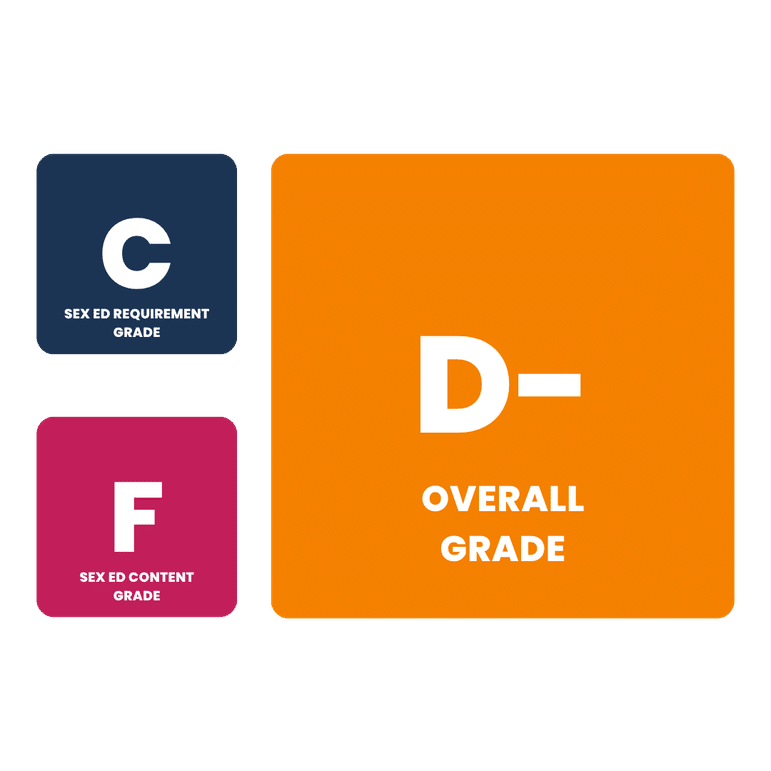
Current Requirement: In Oklahoma, sex education is not required, but instruction on HIV/AIDS is.
- Curriculum must primarily instruct on abstinence.
- Oklahoma has no regulation regarding medically accurate sex education curriculum, but does require HIV/AIDS prevention curriculum to be “medically accurate”.
- Curriculum must include instruction on consent.
- Curriculum is not required to include instruction on sexual orientation or gender identity. Still, it must highlight stigmatizing information such as “engaging in homosexual activity, promiscuous sexual activity, intravenous drug use, or contact with contaminated blood products is now known to be primarily responsible for contact with the AIDS virus.”
- Parents or guardians can submit written notification if they do not want their children to participate in any sexuality and HIV/AIDS courses. This is called an “opt-out” policy.
*In 2026, the overall grade of this state changed slightly from 2025 as a result of a change in our grading methodology. For more information on grading methodology, see the Executive Summary on the State Profiles webpage.
Recent Legislation Shaping the State Landscape
Sex education continues to be a topic of debate among Oklahoma legislators, with legislation introduced over the past several years seeking to restrict the quality of instruction young people receive. In the 2025-2026 legislative session, Oklahoma legislators have introduced bills aiming to make sex education opt-in rather than opt-out- a shift that would significantly reduce access to instruction for many students In 2025, Senate Bill 759, Senate Bill 1282, Senate Bill 1736, Senate Bill 1866, House Bill 1964 were introduced which sought to require parental consent before enrollment in sex education, with the latter also requiring consent for lessons involving social-emotional learning or the use of different pronouns. House Bill 413 was introduced, which would have made a distinction between comprehensive sex education and “sexual risk avoidance education”, also known as abstinence-only, and given preference to the latter while requiring parental consent before sex education (“opt-in”), stigmatizing LGBTQIA+ identities and relationships, and stigmatizing abortion. Similar bills were introduced in 2023-2024, including House Bill 1812, Senate Bill 1563 (which also called for ‘parental concern meetings’), House Bill 3120 (extending opt-in to HIV/AIDS instruction), and Senate Bill 1981 (which also sought to make sex ed abstinence-only and ban external public health organizations from providing sex education).
Two bills attempted to eliminate sex education in 2025 with the introduction of Senate Bill 702, which sought to emphasize “physical” health education and would remove all topics aligning with sex education, and Senate Bill 1737, which would ban sex education altogether. Two similar attempts failed in 2024. House Bill 1780 attempted to create a total ban on sex education instruction, programs, and surveys, while Senate Bill 1879 stated: “only physical fitness, nutrition, substance use and prevention, and injury prevention, and personal health can be taught in Health Education.”
Finally, Oklahoma is no stranger to the legislative trend of “Baby Olivia” bills, which seek to require stigmatizing instruction on fetal development, often involving the viewing of ultrasound videos or the “Meet Baby Olivia” propaganda film created by LiveAction. Three such bills (Senate Bill 587, House Bill 1603, Senate Bill 1668) have been introduced in the 2025-2026 legislative session.
Fortunately, none of these legislative attacks have been successful. Beyond these efforts, two positive bills (Senate Bill 1207 and House Bill 4122) were introduced that would have required the Department of Education to develop curriculum on domestic violence and human trafficking prevention and allow schools to teach it, but these efforts also failed.
Advocates in Action
Advocates can take action to ensure young people in their community have access to quality sex education, not abstinence-only instruction. Advocates can also contact their representatives to defend against pending restrictive legislation and to discuss the need for comprehensive sex education. Advocates are encouraged to use the Community Action Toolkit to strengthen local organizing efforts. For additional guidance, advocates can contact the SIECUS Policy team by emailing [email protected] or join the Sexuality Education Policy Action Council (SEPAC) using our interest form.
More on Sex Ed in Oklahoma…
State Law: A Closer Look
Oklahoma does not require schools to teach sex education. However, according to Oklahoma Statutes 70-11-103.3 and 70-11-105.1, schools are required to provide human immunodeficiency virus (HIV)/acquired immunodeficiency syndrome (AIDS) prevention education. This education must be limited to the “discussion of the disease AIDS and its spread and prevention” and include instruction on consent. The class must be taught once in either grade 5 or 6, once in grades 7–9, and once in grades 10–12. All curricula and materials must be checked for medical accuracy by the Oklahoma Department of Health and must only include “factual medical information for AIDS prevention.” However, the Department explicitly includes factually incorrect information. Specifically: A) AIDS prevention education shall specifically teach students that:
- Engaging in homosexual activity, promiscuous sexual activity, intravenous drug use, or contact with contaminated blood products is now known to be primarily responsible for contact with the AIDS virus;
- Avoiding the activities specified [above] is the only method of preventing the spread of the virus;
- Sexual intercourse, with or without condoms, with any person testing positive for HIV antibodies, or any other person infected with HIV, places that individual in a high-risk category for developing AIDS.
B) The program of AIDS prevention education shall teach that abstinence from sexual activity is the only certain means for the prevention of the spread or contraction of the AIDS virus through sexual contact. It shall also teach that artificial means of birth control are not a certain means of preventing the spread of the AIDS virus, and reliance on such methods puts a person at risk for exposure to the disease.
In addition to HIV/AIDS education, schools must provide health and physical education. Curriculum must include instruction on consent, as well as the ability to obtain, process, and understand basic health information and the services needed to make appropriate health decisions, establish and maintain positive relationships, and make responsible decisions. If a school district chooses to teach sex education beyond the mandated HIV/AIDS and health education, all curricula and materials must be approved for medical accuracy by the state and by the district superintendent. All materials must also be available to parents for review. In addition, all sex education classes must have “the teaching of or informing students about the practice of abstinence” as one of their primary purposes.
A school district must provide written notification of all sex and HIV/AIDS prevention classes. Parents or guardians can submit written notification if they do not want their children to participate in such classes. This is called an “opt-out” policy.
State Standards
Oklahoma’s recently updated Academic Standards for Health Education provide standards for developing health curricula. These standards are required by law. While these standards do include topics such as healthy relationships, they do not mention sex education.
Youth Sexual Health Data
The CDC’s Youth Risk Behavior Survey (YRBS) tracks adolescent health behaviors, including sexual health behaviors. To learn more about Oklahoma’s 2023 YRBS results, click here. The CDC’s School Health Profiles measure school health policies, practices, and the sexual health topics taught in schools. To view Oklahoma’s results from the 2024 School Health Profiles Survey, visit CDC’s School Health Profiles Explorer tool. Visit the CDC’s School Health Profiles for additional information on school health policies and practices.
The quality of sex education taught often reflects funding available for sex education programs. To learn more about federal funding streams, click here.