


New York State of Sex Ed
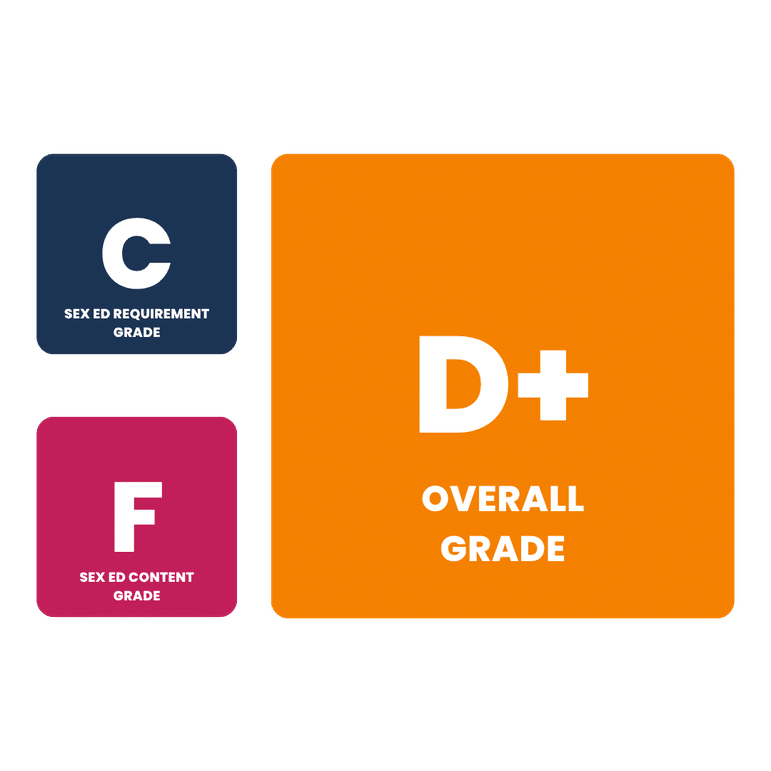
Current Requirement: In New York, sex education is not required, but HIV/AIDS education is required under health education.
- Curriculum must stress abstinence.
- New York statute has no regulation regarding medically accurate sex education instruction.
- Curriculum is not required to include instruction on sexual orientation or gender identity.
- Curriculum is not required to include instruction on consent.
- Parents or guardians may exempt their children from HIV/AIDS instruction as long as the school is given “assurance that the pupil will receive such instruction at home.” This is called an “opt-out” policy.
*In 2026, the overall grade of this state changed slightly from 2025 as a result of a change in our grading methodology. For more information on grading methodology, see the Executive Summary on the State Profiles webpage.
Recent Legislation Shaping the State Landscape
New York advocates have been working tirelessly to advance sex education policy in the state. Over 20 sex education bills were introduced during the 2025-2026 legislative session, but unfortunately none passed. First, lawmakers introduced the “Healthy and Safe Students Act” through companion bills Assembly Bill 7496 and Senate Bill 6901. This bill would mandate comprehensive sexuality education for all public and charter school students in kindergarten through twelfth grade. The developed curriculum would require model curricula, instructional tools, and resources aligned with national standards. The program must be age-appropriate, culturally sensitive, and inclusive of all students, covering topics such as human anatomy, consent, healthy relationships, and prevention of sexual violence. This important legislation represents a step toward a statewide sex education mandate in New York. A similar comprehensive sex education bill was introduced in the 2023-2024 legislative session as Assembly Bill 4604 but ultimately failed. Senate Bill 1021 and its companion Assembly Bill 7767 would have required HIV/AIDS instruction to be medically accurate. A similar set of bills (Senate Bill 9331/Assembly Bill 4370) was introduced in the 2023-2024 legislative session. Six bills (Assembly Bill 538, Senate Bill 3719, Senate Bill 3628/Assembly Bill 736, Senate Bill 1046, Senate Bill 10369) would have required more instruction on assault and abuse prevention topics such as teen dating violence, child exploitation, healthy relationships, and sexting. Two bills, Senate Bill 6227 and its companion Assembly Bill 7557, sought to require instruction on menstrual health disorders as part of health education. Two bills, Senate Bill 6498 and its companion Assembly Bill 5724, were introduced and sought to require instruction on breast cancer and how to perform breast self-examinations. Similar bills (Assembly Bill 5636/Senate Bill 2280) were introduced in the 2023-2024 legislative session but ultimately failed.
One regressive bill, Assembly Bill 3773, was also introduced in the 2025-2026 session that sought to require students under 10 to get parental consent before receiving sex education. A similar bill, Assembly Bill 9870, was also introduced in the 2023-2024 legislative session, but neither bill advanced.
Advocates in Action
Advocates in New York can contact their representatives to discuss the critical need for a statewide comprehensive sex education mandate, beyond already required HIV/AIDS prevention education. Advocates are encouraged to use the Community Action Toolkit to strengthen local organizing efforts. For additional guidance, advocates can contact the SIECUS Policy team by emailing [email protected] or join the Sexuality Education Policy Action Council (SEPAC) using our interest form.
More on Sex Ed in New York…
State Law: A Closer Look
In New York, Regulations of the Commissioner of Education (§ 135.3) require health education for all students in grades K–12. This instruction must provide information about human immunodeficiency virus (HIV)/acquired immunodeficiency syndrome (AIDS). Teachers must teach HIV/AIDS instruction and must receive appropriate training and materials from the board of education or trustees.
All HIV/AIDS education must “provide accurate information to pupils concerning the nature of the disease, methods of transmission, and methods of prevention.” This instruction must be age-appropriate and consistent with community values and “shall stress abstinence as the most appropriate and effective premarital protection against AIDS.” Each local school board must establish an advisory council to recommend HIV/AIDS instruction. Local boards of education may distribute condoms in schools. They must ensure that all students who have access to condoms have taken part in an HIV/AIDS education program.
Parents may exempt their children from HIV/AIDS classes as long as the school is given “assurance that the pupil will receive such instruction at home.” This is called an “opt-out” policy.
State Standards
New York state does not require or suggest a specific curriculum. Still, it does provide a curriculum framework: the Learning Standards for Health, Physical Education, and Family and Consumer Sciences at Three Levels. The framework does not specifically mention sex education, though certain topics within sex education are included, such as “understanding of the changes that accompany puberty.” New York State also provides A Guidance Document for Achieving the New York State Standards in Health Education, which is intended only as a guide for developing health curricula. Topic areas mentioned include sexual risk, family life, and sexual health, as well as the prevention of HIV/AIDS, sexually transmitted diseases (STDs), and pregnancy.
Youth Sexual Health Data
The CDC’s Youth Risk Behavior Survey (YRBS) tracks adolescent health behaviors, including sexual health behaviors. To learn more about New York’s 2023 YRBS results, click here. The CDC’s School Health Profiles measure school health policies, practices, and the sexual health topics taught in schools. To view New York’s results from the 2024 School Health Profiles Survey, visit CDC’s School Health Profiles Explorer tool. Visit the CDC’s School Health Profiles for additional information on school health policies and practices.
The quality of sex education taught often reflects funding available for sex education programs. To learn more about federal funding streams, click here.