


New Mexico State of Sex Ed
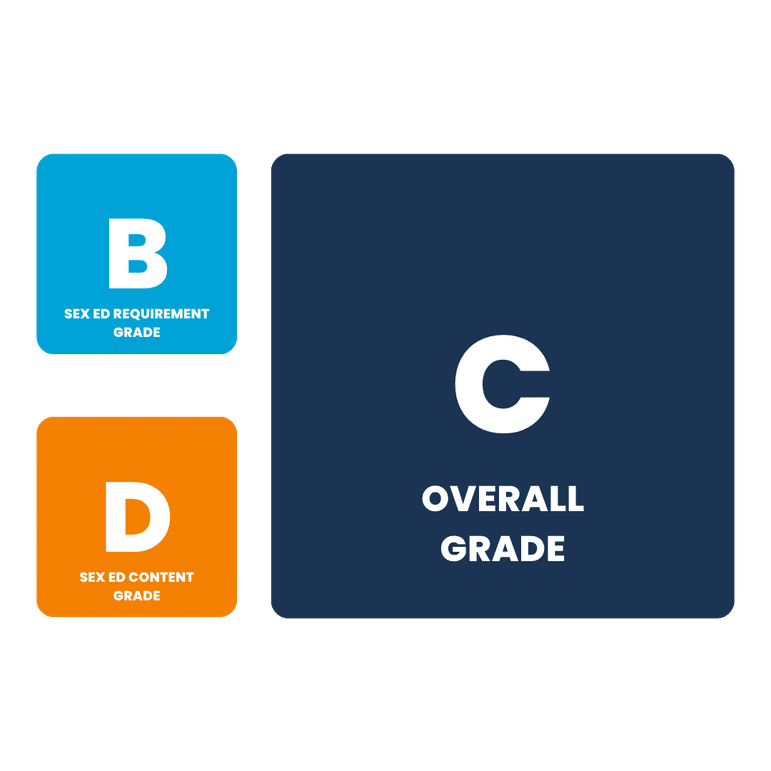
Current Requirement: New Mexico schools must provide sex education through state health standards.
- Curriculum is required to stress abstinence.
- The curriculum must include HIV/AIDS prevention.
- Curriculum is not required to include instruction on sexual orientation or gender identity.
- Curriculum is not required to be medically accurate.
- Curriculum is not required to include instruction on consent.
- Parents and guardians can request to remove their student from sex education instruction. This is referred to as an “opt-out” policy.
*In 2026, the overall grade of this state changed slightly from 2025 as a result of a change in our grading methodology. For more information on grading methodology, see the Executive Summary on the State Profiles webpage.
Recent Legislation Shaping the State Landscape
Advocates in New Mexico continue to try to advance sex education through policy in recent legislative sessions. Most recently in 2026, House Memorial 10 was introduced and requested that the Legislative Education Study Committee (LESC) conduct a comprehensive review of the state’s human sexuality education standards and programming, highlighting the prevalence of sexual activity among youth and the associated risks, such as unintended pregnancies and sexually transmitted infections, and emphasizing the importance of evidence-based, comprehensive sexuality education within the bill text. The bill ultimately failed. During the 2025 legislative session, SB 258 attempted to mandate comprehensive human sexuality education in public schools. The bill proposed that, starting in the 2027–2028 academic year, middle and high school students receive instruction encompassing topics such as consent, healthy relationships, sexual orientation, gender identity, and reproductive health.
Additionally, SB 258 sought to mandate medically accurate information on all methods of preventing unintended pregnancy and STIs; pregnancy outcome options, including adoption, abortion, and parenting; the link between Human Papillomavirus (HPV) and cancer; other types of cancer affecting the reproductive organs; and consent, as well as ways to identify and prevent sexual and physical violence- all presented in an inclusive, shame-free, and unbiased manner. This legislation would have also required the Public Education Department to develop academic content and performance standards for this curriculum and establish a process to approve school districts’ curricula. While both these efforts were unsuccessful, they are indicative of advocates’ continuous efforts to improve access to quality sex education for the young people of New Mexico.
Advocates in Action
Advocates can take action to ensure young people in their community have access to quality sex education by contacting their local school board to determine what topics are missing from sex education instruction, such as instruction on consent, sexual orientation and gender identity, and what curriculum is being used. They can then voice the need to align current health education standards with the National Sex Ed Standards.
Advocates can also contact their representatives to discuss the critical need for a statewide mandate for comprehensive, medically accurate, and inclusive sex education. Advocates are encouraged to use the Community Action Toolkit to strengthen local organizing efforts. For additional guidance, advocates can contact the SIECUS Policy team by emailing [email protected] or join the Sexuality Education Policy Action Council (SEPAC) using our interest form.
More on Sex Ed in New Mexico…
State Law: A Closer Look
New Mexico Administrative Codes §§ 6.12.2.10, 6.29.6.8, and 22-13-1.1.1 require schools to teach a health education course in either middle or high school. Each school district must “provide instruction about [human immunodeficiency virus] (HIV) and related issues in the curriculum of the required health education content area to all students in the elementary grades, in the middle/junior high school grades, and in the senior high school grades.” This instruction must include “ways to reduce the risk of getting HIV/[acquired immunodeficiency syndrome] (AIDS), stressing abstinence.” Outcomes of such instruction should include the “ability to demonstrate refusal skills, overcome peer pressure, and use decision-making skills.”
Local school districts determine educational materials and the grade levels at which they are introduced. All instruction must be age-appropriate. Local school boards must “ensure the involvement of parents, staff, and students in the development of policies and the review of instructional materials.” The state neither suggests a curriculum nor limits what may or may not be included in sex education instruction.
New Mexico Administrative Code 6.29.6.3 requires schools to adopt academic content and performance standards and measure performance in public schools.
State Standards
The Health Education Content Standards include “abstinence education” instruction beginning in grades 3 and 4. Beginning in grades 7 and 8, performance standards in health education include understanding “how healthy alternatives can replace unhealthy behaviors (i.e., abstinence, condom use, [and] other pregnancy prevention methods).” Students in grades 9 through 12 are to demonstrate knowledge of pregnancy prevention that includes various methods of contraception, such as hormonal methods and the proper use of condoms. The curriculum also covers strategies for maintaining healthy relationships and addressing harmful relationship behaviors. It includes the impact of cultural and media portrayals of gender roles as a discussion topic.
The standards state that each school district must have a policy allowing parents to “request that their child be exempted from the parts of the health education curriculum that address the sexuality performance standards.” School districts must create alternative lessons for exempted students. This is called an “opt-out” policy. Local school boards must include parents, staff, and students in developing their own opt-out policy.
Youth Sexual Health Data
The CDC’s Youth Risk Behavior Survey (YRBS) tracks adolescent health behaviors, including sexual health behaviors. To learn more about New Mexico’s 2023 YRBS results, click here. The CDC’s School Health Profiles measure school health policies, practices, and the sexual health topics taught in schools. To view New Mexico’s results from the 2024 School Health Profiles Survey, visit CDC’s School Health Profiles Explorer tool. Visit the CDC’s School Health Profiles for additional information on school health policies and practices.
The quality of sex education taught often reflects funding available for sex education programs. To learn more about federal funding streams, click here.