


New Hampshire State of Sex Ed
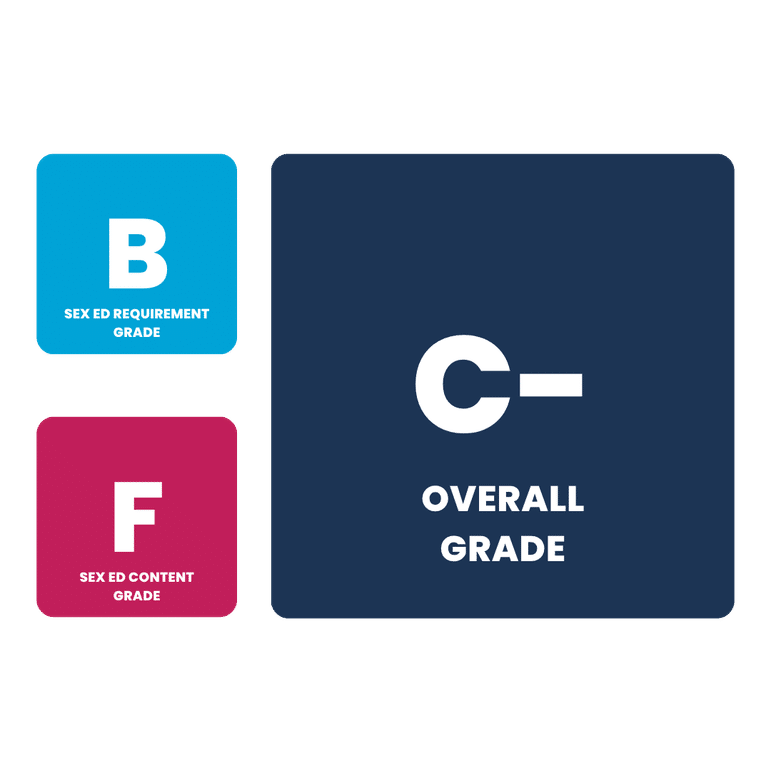
Current Requirement: New Hampshire requires sex education as part of health education and mandated health education standards.
- New Hampshire has no statute regarding instruction on abstinence. However, the Health Education Curriculum Guidelines emphasize abstinence as the most effective prevention method.
- HIV/AIDS and STI instruction is required.
- New Hampshire has no regulation regarding medically accurate, age-appropriate, evidence-based, or inclusive sex education instruction.
- Curriculum is not required to include instruction on sexual orientation, gender identity, or consent. However, curriculum must include instruction on dating violence and date rape.
- Parents or guardians may remove their children from sex education instruction based on religious objections. This is called an “opt-out” policy.
*In 2026, the overall grade of this state changed slightly from 2025 as a result of a change in our grading methodology. For more information on grading methodology, see the Executive Summary on the State Profiles webpage.
Recent Legislation Shaping the State Landscape
Advocates have worked diligently to try to advance sex education in New Hampshire but have faced significant challenges in passing statewide measures to advance sex and health education. In 2026, lawmakers introduced House Bill 1077, which would have required domestic violence to be taught as part of health education, but it died in committee. Contrastingly, much of the sex education legislation introduced in New Hampshire in this session and in the past has been restrictive. House Bill 1493 was also introduced this session. It would have required gestational development videos, similar to the “Meet Baby Olivia” fetal development videos, to be shown as a part of health education. A similar bill, House Bill 667, almost passed in 2025 and would have required gestational development videos and abstinence as part of health education. The bill did contain one positive element of sex education, as it would require health education to include medically accurate and age-appropriate sexuality education. However, the governor ultimately vetoed the bill. Another bill, House Bill 662, died in committee, but sought to require public schools to show abortion procedure videos as part of health education in grades 9-12, with enforcement mechanisms from the Attorney General’s office. The proposed videos would also have been developed by Live Action, the same group behind the “Meet Baby Olivia” video. These efforts seek only to increase misinformation about abortion and perpetuate abortion stigma in a state that is already restrictive for abortion access. In 2024, lawmakers passed House Bill 1312, which adds to the 2017 law that mandates two weeks’ advance notice to parents before instruction of human sexuality or human sexual education. This advance notification now also applies to gender identity and sexuality. Another restrictive 2024 sex education bill, House Bill 1185, which would have restricted student participation in sex education with an opt-in policy and restricted instruction in specific grade levels, was thankfully unsuccessful.
In addition to struggles over sex education policy, lawmakers have taken steps to enshrine parental rights while weaponizing the concept to add administrative barriers for educators this year. In 2025, lawmakers passed House Bill 10, also known as the “Parental Bill of Rights,” a comprehensive statute on parental rights in New Hampshire that establishes parents’ fundamental right to direct the upbringing, education, and care of their minor children. The bill states that schools cannot withhold information about students’ health, well-being, and education from parents. It reaffirms that parents can object and remove children from sex education. This potentially creates a “forced outing” policy for LGBTQIA+ students, and any school employee who “encourages or coerces, or attempts to encourage or coerce, a minor child to withhold information from his or her parent” would face disciplinary action.
Advocates in Action
Advocates can take action in New Hampshire to improve sex education content requirements. They can contact their local school district to identify what curriculum is being used to teach the portion of sex education under health education. They can also contact their state department of education to push for alignment with the National Sex Ed Standards.
Advocates can also contact their representatives to discuss the critical need for requiring sex education to be medically accurate, evidence-based, and comprehensive. Advocates are encouraged to use the Community Action Toolkit to strengthen local organizing efforts. For additional guidance, advocates can contact the SIECUS Policy team by emailing [email protected] or join the Sexuality Education Policy Action Council (SEPAC) using our interest form.
More on Sex Ed in New Hampshire…
State Law: A Closer Look
In New Hampshire, according to Revised Statutes §§ 186:11 and 189:10, local school boards must “ensure that health education [is] taught to pupils as part of the basic curriculum” and “that all studies prescribed by the state board of education are thoroughly taught, especially physiology, hygiene, and health and physical education as they relate to the effects of … human immunodeficiency virus (HIV)/acquired immunodeficiency syndrome (AIDS), and sexually transmitted diseases [STDs] on the human system.” The Department of Education must develop curriculum frameworks that address those subjects and provide information on HIV/AIDS to all public and private schools to help them develop courses and programs.
Additionally, Revised Statutes § 193-E:2-a specifies that “public schools and public academies shall adhere to the standards identified” for health education. The standards, which were defined and identified as the school approval standards beginning in the school year 2008-2009, cover “kindergarten through twelfth grade and shall clearly set forth the opportunities to acquire the communication, analytical and research skills and competencies, as well as the substantive knowledge expected to be possessed by students at the various grade levels.”
State law requires “school districts to adopt a policy allowing an exception to a particular unit of health or sex education instruction based on religious objections.” This is called an “opt-out” policy. As of 2017, New Hampshire law requires school districts or classroom teachers to provide a minimum of two weeks’ advance notice to parents before instruction of human sexuality or human sexual education. As of 2024, this policy also applies to instruction on ”sexual orientation, gender, gender identity, or gender expression” with the passage of House Bill 1312.
State Standards
New Hampshire produced the Health Education Curriculum Guidelines in 2003. The guidelines specify that in elementary school, instruction on family life and sexuality should cover: families and relationships, growth and development, and HIV/AIDS (including explaining that HIV is not transmitted through casual contact and discussing the importance of having compassion for people with HIV/AIDS). In middle school, this instruction should cover: families and relationships, growth and development, sexual behavior, HIV and other STI prevention, and pregnancy prevention. In high school, this instruction should cover: families and relationships (including violence and date rape), sexual behavior, HIV and other STI prevention, and pregnancy prevention. The guidelines state that abstinence is the most effective means of preventing pregnancy, HIV, and other STIs.
Youth Sexual Health Data
The CDC’s Youth Risk Behavior Survey (YRBS) tracks adolescent health behaviors, including sexual health behaviors. To learn more about New Hampshire’s 2023 YRBS results, click here. The CDC’s School Health Profiles measure school health policies, practices, and the sexual health topics taught in schools. New Hampshire’s 2024 School Health Profiles response rate was not high enough to be representative and thus is excluded from the CDC’s School Health Profiles Explorer tool. Visit the CDC’s School Health Profiles for additional information on school health policies and practices.
The quality of sex education taught often reflects funding available for sex education programs. To learn more about federal funding streams, click here.